
JELADO Manufacturing ~Vintage Wool~ Vol. 3 "Vintage Wool Reborn for the Modern Age"
Top Page > JELADO Manufacturing > Vintage Wool > Vol.3
~Part 3: "Sewing" - Finally, delivery!~

If "fortuitous products born of an era" are AMERICAN VINTAGE, then the products JELADO aims for can be described as "the tenacity to make coincidence a certainty." It is out of respect for AMERICAN VINTAGE, which could be called natural monuments remaining on Earth, that they find inevitability even in past coincidences, tirelessly pursuing quality as a "modern product" rather than "simplistic imitation."
Therefore, JELADO's creations sometimes feature specifications that cannot exist in AMERICAN VINTAGE. The meticulously precise "pattern matching" of the blankets introduced in this project is a good example. Even if the physical difficulty is extremely high, they find meaning in bringing it to fruition, aiming for end-users living in the "present" to feel the high quality of it as a "modern" product. We hope that their passion will be conveyed through this project.
Now, for this third installment, we bring you the process of the fabric, which underwent "STEP.8 Pressing" in the previous coverage, being cut and sewn to completion as a product. The destination was Alpha Co., Ltd., which handles cutting and sewing for numerous brands with internationally unshakeable reputations. We will deliver the final chapter of this relay of pride, spun by Japan's leading professionals in Bishu, one of the world's three major wool textile producing regions.


STEP.9 "Pattern Matching"
The first step when the finished fabric arrives at Alpha Co., Ltd., which is responsible for cutting and sewing, is to examine how to cut the parts that make up a single product from the fabric. The process of arranging patterns on the fabric may seem simple at first glance, but it is extremely difficult because the patterns must be placed in a way that ensures proper pattern matching when the product is finished. Just imagining drawing complex 3D sewing images and 2D cutting images simultaneously in one's head while considering pattern matching for parts extraction is enough to make one dizzy.

"It's also important to use valuable fabric without waste."
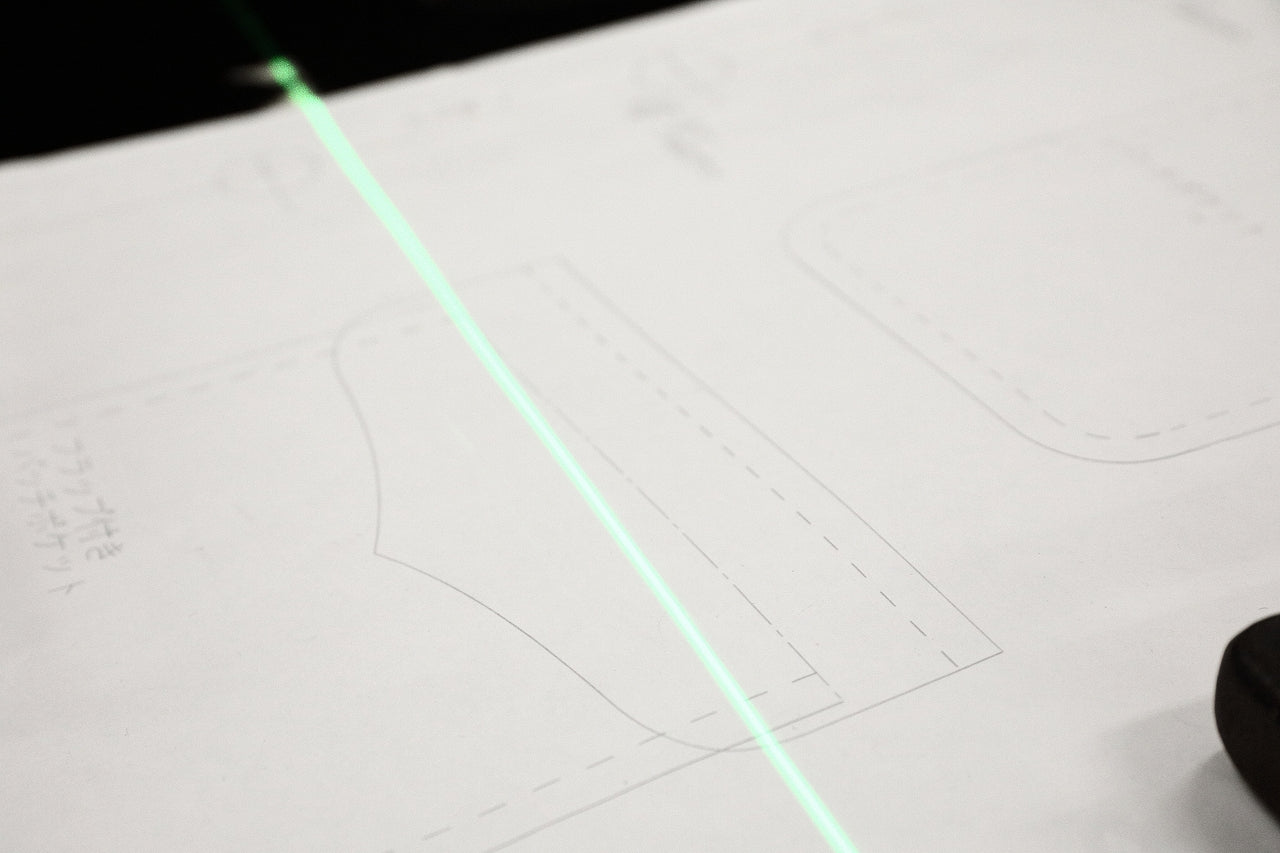
"Basically, we place the larger pattern pieces first, and then arrange the smaller pieces to match that pattern placement. However, with fabric like this, which has a large pattern design pitch, if we don't place the patterns skillfully, it will result in a huge amount of fabric loss, so that's the difficult part," says craftsman Yonekura. He also adds that even a slight misalignment can lead to significant risks in later processes, so they constantly use lasers to prevent misalignment. However, working while also accounting for fabric distortion is extremely difficult.

STEP.10 "Cutting Preparation"
Once the general placement of the patterns is determined, the next step is the cutting process. When layering the paper with the transferred patterns onto the fabric, a significant hurdle awaits the craftsmen here as well. Not only does each roll of fabric have different degrees of distortion, but even within a single roll, the tension of the weave can vary by location, requiring constant adjustment of the paper's position.

This fact means that, for example, if two cuts are made, there will be a slight error in the pattern cutting position between the first and second cuts. If parts cut in the first pass are mixed with parts cut in the second pass during sewing, the pattern matching will be subtly off upon completion. In other words, all parts cut in one pass must be assigned a matching number, and during sewing, only that specific set can be sewn together, which creates additional work.

Furthermore, for thin fabrics that do not require pattern matching, dozens or hundreds of layers can be stacked and cut at once. In contrast, for thick, worsted fabrics with large pattern pitches and varying degrees of distortion depending on the part and climate, the number of layers that can be stacked during cutting is extremely limited, making it very inefficient. Therefore, before cutting, the fabric is divided into three sections to make misalignment adjustments easier.


" 'Troublesome' - strangely, I've never thought that."
"People often tell me that it must be tough to repeatedly make such elaborate products like this. However, we actually don't see these processes as repetitive work. That's because for us, even if the work seems the same, if even one condition, like the fabric's condition, is different, it becomes a completely different task, which provides a kind of stimulation. I think my own pride in my work makes me feel that way," says Yonekura.
STEP.11 "Cutting"
Due to the thickness of the fabric and the need for delicate work with the pattern, the only cutting machine that can be used for the cutting process is a freehand type. The cut lines, drawn in a single stroke, are truly divine, with exquisite curves and intricate sections appearing as if cut by a machine. Although the work proceeds efficiently, the fabric's alignment must be checked and adjusted after each section is cut, which naturally limits the maximum amount that can be cut in a day to just a few jackets.


No matter how efficiently cutting is performed, fabric scraps are inevitably generated when prioritizing pattern matching for the finished product. The sheer volume of scraps, as seen in the photo below, should convey the difficulty of adhering to such precise standards.

STEP.12 "Sewing"
Once cutting is complete, it's time for the sewing process. In this task, too, the craftsmen's struggles are compounded by the fabric's thickness and pattern matching. For sewing, it's not just that the sewing machine cannot run at high speeds due to the durability of the needles and threads. The tension on the front and back of the fabric also changes, so they have to constantly correct 3D misalignments little by little, sometimes even tapping the fabric with a hammer to proceed with the work.


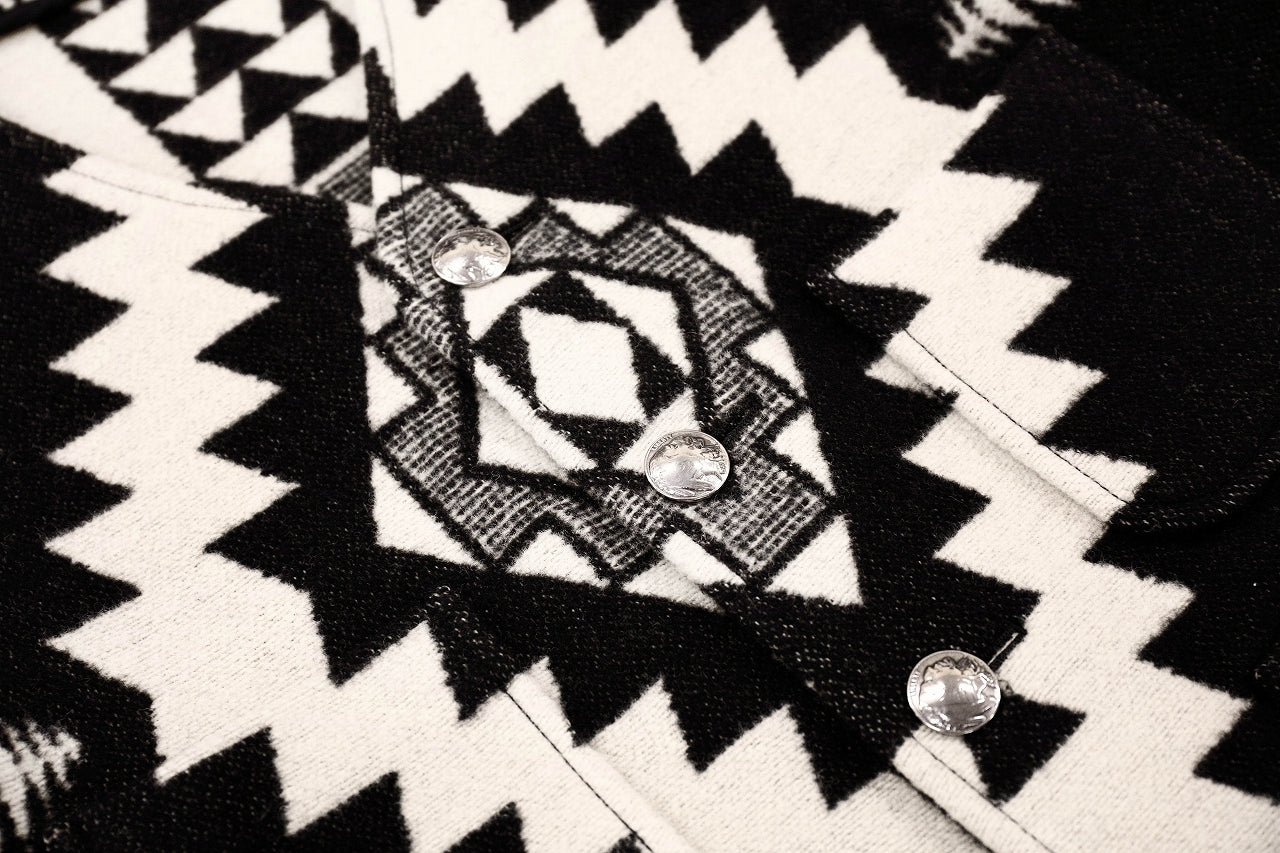
Regarding pattern matching, overlapping fabrics, especially in areas like pockets, are the most challenging. If one prioritizes only the pattern when sewing, the pocket might end up in a slightly different position than specified in the design document. Conversely, if one only follows the design document, the slight distortions in the fabric can cause the pattern matching to fail. However, the fact that neither of these issues is noticeable in the delivered product is due to the subtle adjustments made by the craftsmen's intuition, which cannot be quantitatively explained.
"The specifications are just a guide. The designer's intent is our blueprint."
"For example, we often do things differently from the specifications, such as cutting the pattern a few millimeters larger to ensure an optimal seam allowance considering the fabric thickness, or using a blind stitch finish for the hem even if the specifications say to use a Lewis stitch," says Mr. Yonekura.
"To put it bluntly, the people who plan the products are professionals in planning, not in cutting or sewing. We believe it's our duty to fully respond to their 'planning professionalism' as 'cutting and sewing professionals.' That's why, after understanding the intent of the specifications, if we don't think it's the best instruction, we must clearly communicate that. I believe that's what it means for professionals to work together."

STEP.13 "Inspection"
Once sewing is complete, the products undergo a final check for loose threads or needles before shipment. From spinning to inspection, each garment is carefully produced by hand, right down to the very end. If you ever have the opportunity to hold one of these products, we hope you'll reflect on the production background we've introduced through this series of interviews.

Finally...
The reality is that it's not one big scientific technology that creates things, but small, excellent human skills that support craftsmanship. Certainly, there are many cases in the world where machines are better than humans in terms of efficiency and accuracy. However, in fields like fashion and "culture," which cannot be quantitatively measured, it is hard to imagine a future where machines surpass human skill. This is because, in this domain, the judgment is clear when weighing the immense human, financial, and time costs of developing machines that surpass humans against the potential for human skill production and transmission during that same period.
Nevertheless, in Bishu, factories with the kind of technical prowess introduced in this project are on the decline. This is a sad reality. Perhaps in the near future, an era will come where products like those introduced here will be desired but unattainable, just like AMERICAN VINTAGE...
First, to know this fact. Perhaps that is what is important for those who engage with "culture." That's how I felt during this interview.
<Text by Kobota Kata / Photos by Seiji Sawada>
Jackets made from revived vintage wool can be found here