
JELADO Manufacturing ~Vintage Wool~ Vol.2 "Vintage Wool Reborn in the Modern Era"
Top Page > JELADO Manufacturing > Vintage Wool > Vol.2
~Part 2: "Finishing Process" - When fabric comes to life~

"Dedication." The definition is extremely vague, and at times, it can be a fragile indicator influenced by human sensibility. On the other hand, there are still products "today" that reveal such "dedication" without needing to use that word.
JELADO, with its AMERICAN VINTAGE background, says:
"We are not recreating masterpieces, but rather recreating the emotion we felt back then."
It is planned by human passion, realized by human passion, and appears in the city with human passion. The foundation of such manufacturing, where "passion" drives and creates "dedication," is a high-level "norm." And this project aims to convey the relay of pride spun by numerous professionals representing Japan.
In this second installment, we follow the process from the blanket woven in the "STEP 3: Weaving" process, which we covered last time, being neatly prepared and delivered as "fabric." This is what is known in the industry as the "finishing process." We headed to SOTOH Co., Ltd., a company with world-class technological capabilities in finishing. It is a factory that balances the inheritance of analog techniques, which can be called traditions cultivated in Bishu, with the development of digital technologies utilizing the latest technology.
Witness how the pride of manufacturing, which has continued since 1923 (Taisho 12), harmonizes with JELADO's planning and takes shape.

STEP 4: "Rope Washing"
After weaving is complete, the blanket delivered as "fabric" is sent to the "rope washing" process. Newly woven fabrics are stiff to the touch and have a lot of machine oil and dirt attached, so these are removed here, and at the same time, the fabric is kneaded to align its weave. Usually, the only purpose of this process is to clean the fabric, but at this factory, preparations are also made at this stage to adjust the condition of the fabric.


"If there's no added value, there's no point in humans doing it."
According to the craftsman, "Even if it's a machine operation, only humans can add value to every task. For example, if too much wool oil attached to the fabric is removed, the texture will be too compromised, and even for the same fabric, the machine running time and timing, and the frequency of changing the washing water will differ. Our job is to always finish the fabric in perfect condition, taking all of this into account. The desire to create truly good products is our motivation." They have been finishing fabrics in Bishu for about 100 years. Their pride truly lives on there.

STEP 5: "Dehydration and Drying"
After the fabric is washed in the rope washing process, it is dehydrated and then sent to the drying process. It is put through a machine called a "width-setting dryer," where it is dried with hot air, and at the same time, the width of the blanket is standardized. Here again, it's not just about drying; an original recipe resin liquid is used to give it texture and body. Incidentally, the unit indicating the processing equipment for fabric dyeing and finishing businesses is said to be the number of these width-setting dryers.


STEP 6: "Napping"
"Napping" is the process of raising the nap on the front and back of the fabric using rolls with sharp wires embedded in them. The optimal napping method and number of times for each fabric are determined after numerous tests with sample fabrics. While the specific number of napping cycles in this case is a trade secret and cannot be disclosed, the blankets were put through this process multiple times in a precisely calculated order, such as alternating between front and back, or continuous cycles on each side.

What's astonishing is that if, for example, the fabric is napped from the front to the back and then to the front again, they undo and re-tie the seam allowance to connect each "tan" (approximately 25m) every time. When asked why, the answer was refreshingly simple and clear: "Because if we prioritize efficiency and do it all at once, the finish won't be beautiful."

"Our intangible senses, which cannot be expressed numerically, operate the machines."
As the craftsmen say, "The important thing in this process is the precision of the napping machine's adjustments." Even with the same fabric, the conditions change depending on the condition of the delivered lot, so there's no clear "if you do this, that happens" data in this world. The only reliable sources are the accumulated knowledge from about 100 years of the company's founding and the experience of each craftsman.
During the discussion with the craftsmen, one interesting remark stood out. "Japanese machines made decades ago are easier to use than the latest Italian napping machines where you just input numerical values," they said. Apparently, turning the handle to adjust the napping depth and visually observing how the fabric is napped makes it easier to achieve the subtly ideal texture that cannot be expressed numerically.

"That's precisely why this production process cannot be manualized. There are simply too many 'tricks' in each step that only seasoned craftsmen who handle these machines understand. We might be able to set certain standards and create a system more suited for mass production, but our pride as craftsmen prevents us from doing so... Honestly, it's not very efficient (laughs)."
STEP 7: "Shearing"
After napping, the raised nap on the fabric surface is uneven, so it is trimmed to a uniform length in a process called "shearing." While the napping process is important in finishing the fabric, shearing is said to be a very crucial step because it greatly affects how the fabric's color and pattern appear, as well as its texture when touched.
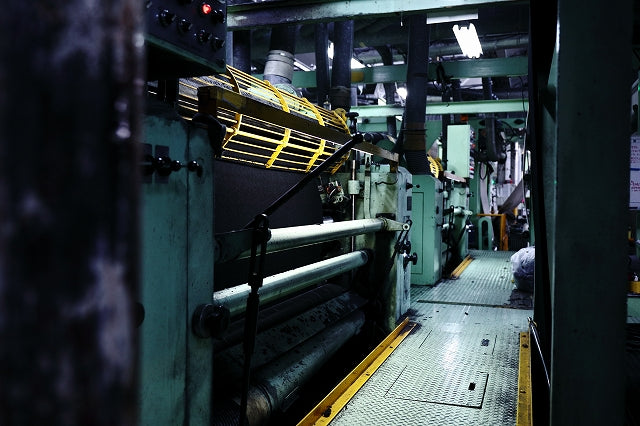
"It's important to understand the intent of the instructions, not just follow them exactly, and still achieve the desired outcome."
The craftsman says, "Shearing is a process that largely determines the impression end-users have when they pick up a fabric. That's why this task requires extreme caution to maximize the dedication put into the napping process. The finish can vary significantly depending on the person operating the machine. In all our work, there are 'instruction sheets' created by those directing the fabric, but we don't just follow the numbers written there. We genuinely understand the intent behind those numbers and then interact with the machines. We consider the condition of the shearing blades, the fabric's condition, and the subtle differences between each lot. Sometimes, we do things differently from the instruction sheet. But what's important is the result, not the process. That's how manufacturing should be done."
STEP 8: "Pressing"
The final finishing step before delivering the fabric to the factory for cutting and sewing is the "pressing" process. This aims to smooth the fabric surface and give it a sheen. The fabric is placed between felts, and the surface texture is adjusted with high-temperature steam and pressure. In the case of the blanket planned by JELADO this time, it is intentionally pressed softly to express the texture and three-dimensionality of AMERICAN VINTAGE.

And, to be continued...
A major insight gained through this interview was the fundamental importance of the finishing process, which rarely gets the spotlight compared to "weaving" when discussing textiles. Also, while "the amazingness of craftsmen" often brings to mind images of craftsmen working with analog tools, a passionate, almost analog, ethos also thrives in craftsmen operating large-scale machinery. In conclusion, human skill makes a significant difference in the final product.

It was a day that made JELADO's words resonate deeply: "The finishing of a fabric holds everything that breathes life into it, and these rationally accumulated processes deserve more attention." Furthermore, the essence of JELADO's value seemed to lie in their approach to manufacturing, which is more logical and meticulous than when the masterpieces of the past were created, despite having AMERICAN VINTAGE as their background.
Next time, we will focus on the "cutting" and "sewing" processes, showing how the blanket, finished as "fabric" in this interview, becomes an apparel product.
<Text by Koho Tagata / Photos by Seiji Sawada>
~Part 3: "Sewing" - Finally, off to delivery!~ is here
Jackets made based on revived vintage wool are available here