
JELADO Manufacturing ~Vintage Wool~ Vol.1 "Vintage Wool Revived for the Modern Era"
Top Page > JELADO Manufacturing > Vintage Wool > Vol.1
~Vol. 1: "Spinning" and "Weaving"~

For brands that develop products based on "AMERICAN VINTAGE," reproducing products that use wool as a fabric is difficult in a different sense than with denim and leather products.
This is because wool itself was a valuable commodity more than half a century ago, and it was often re-used during spinning, which makes fabric analysis difficult. Furthermore, the weaving machines themselves are rare globally, and skilled personnel to maintain them are scarce, creating significant obstacles to product commercialization. Even if these hurdles are cleared, the problem of skyrocketing product prices cannot be overlooked.
This time, over three installments, we will reveal how JELADO was able to create wool that is as close as possible to "AMERICAN VINTAGE," why they are so committed to realism, and how they can release products at their current prices, mainly by examining the production process.
Bishu: One of the World's Three Major Wool Textile Producing Regions
Bishu, an old name referring to the western part of present-day Aichi Prefecture and the southwestern part of Gifu Prefecture, is known as one of the world's three major wool textile producing regions, alongside Huddersfield in the UK and Biella in Italy. This area, blessed with water sources from the Kiso, Nagara, and Ibi rivers, has been engaged in fabric production since ancient times, dating back to the Yayoi period. Wool textile production began in this area in the Meiji era, coinciding with the period when wool imports commenced in earnest to meet domestic demand for military uniforms. The reason why products born in Bishu are so highly regarded both domestically and internationally lies in the fact that all processes—spinning, twisting, dyeing, weaving, knitting, and finishing—are completed within the area, making Bishu itself a single factory. Over more than a century, the accumulated skills of each professional and their close collaboration have created wool textiles of a quality unmatched elsewhere, or, to be precise, that others cannot replicate.

To revive vintage pieces in the modern era, JELADO relies on Mr. Mitsuzaki, the representative of Hinode Boseki. This company has established a solid position within Bishu and continues to produce goods with the craftsmanship of a bygone era, even in 2018. The process of creating fabric begins by drawing from numerous vintage samples held by JELADO, as well as Hinode Boseki's vast collection of fabric samples from around the world, dating back to the 19th and 20th centuries. Once a base vintage is selected, the valuable vintage piece is carefully cut, and professionals from each production stage begin to analyze the fabric to reproduce its original construction.
It takes at least five to six months to create two test samples from the planning stage. Few apparel manufacturers globally incorporate such extensive and costly dedication into their products, mainly because such commitment directly impacts product pricing. JELADO addresses this issue by ordering a massive quantity of fabric and operating it as a product. According to Mr. Mitsuzaki, "From our perspective, having seen various fabrics, reproducing vintage wool is extremely difficult. This is because too many techniques have been lost worldwide compared to other genres. Even here in Bishu, the number of factories capable of fulfilling orders like JELADO's is decreasing year by year. Therefore, JELADO's presence is extremely important in terms of preserving the techniques that have been passed down throughout Bishu."
Now, let's look at the process of how JELADO and Hinode Boseki produce wool fabric, utilizing rare techniques that remain in modern times.

STEP.1 "Spinning"
Our first visit was to Mikawa Bomo. This is a spinning factory, where the initial and crucial process of creating fabric, "spinning" (i.e., making yarn), takes place, significantly influencing the final finish. In the case of wool, yarns are broadly divided into "worsted yarn," made from thin, long fibers primarily for suits, and "woolen yarn," made from shorter fibers to produce thicker wool fabrics. JELADO commissions "woolen yarn," which, like vintage wool, is easily napped and highly insulating. This factory handles all kinds of spinning and is a well-known establishment in Bishu for its ability to "turn any fiber into yarn." Incidentally, only about 20 factories in Japan are left that can produce "woolen yarn."

The difficulty of reproducing vintage wool
According to Mr. Hamaya, the representative of Mikawa Bomo, the most challenging aspect of reproducing vintage wool is fabric analysis.
"More than half a century ago, wool fabrics were rare, and recycled wool was often included during the spinning stage. Therefore, to revive it today, we first have to analyze what color, where it's from, and how much of each type of wool is contained in the base wool itself, down to less than 0.01%. We proceed with analysis by estimating the logistics of wool at the time, based on the place and era of production, but it's an enormous task (laughs). Orders as detailed as JELADO's are tough, but they also give us a chance to differentiate ourselves technically, so it's a challenge we welcome," says Mr. Hamaya. As you can see in the photos, even what appears to be a "brown" yarn in its finished state is actually a fine blend of various types of wool. Reproducing vintage pieces makes this even more complex.

Until the wool yarn is made
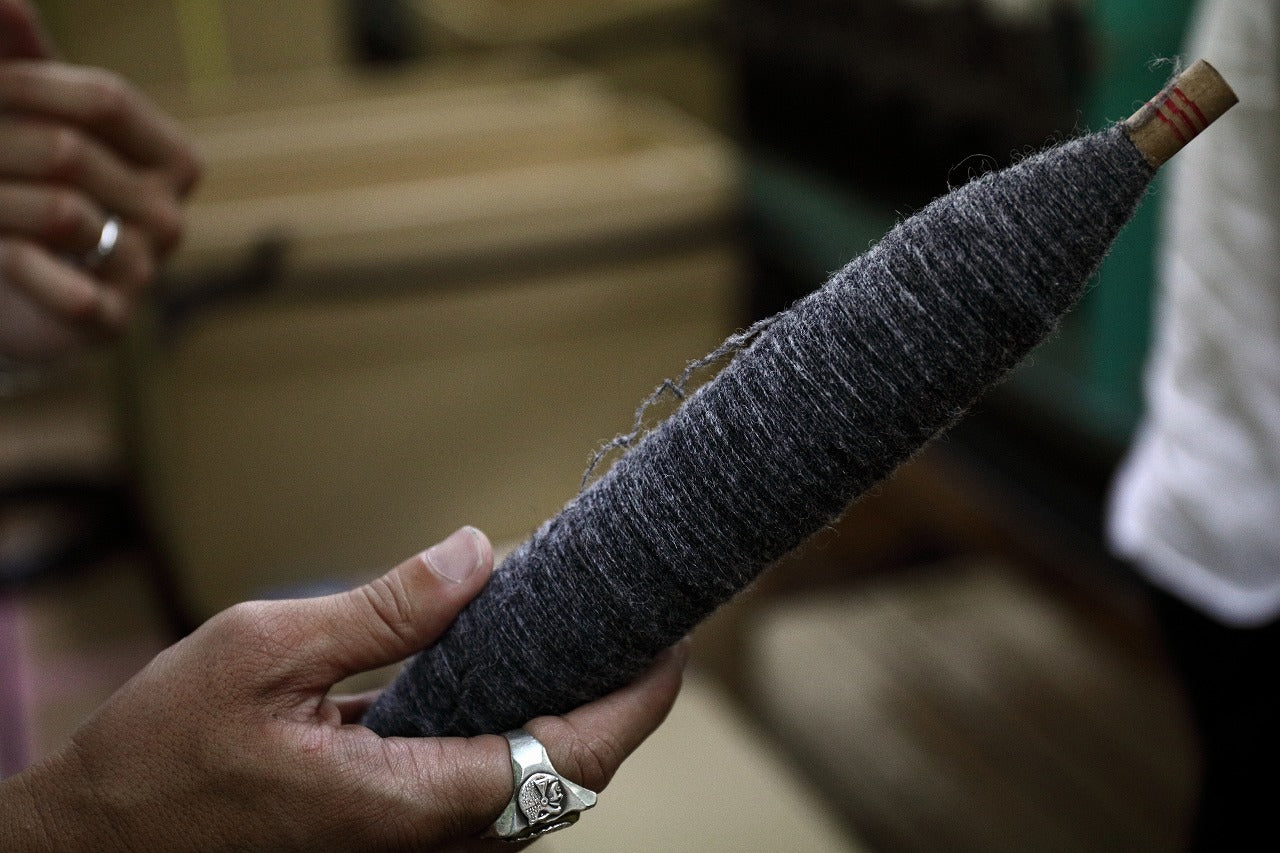
The process of making wool is mainly divided into four steps: "Blending," which involves selecting wool and evenly blending it while opening the fibers and adding conditioning oil; "Carding," where the blended wool is rotated through rollers to create an even, mille-feuille-like fiber web, which is then formed into fiber bundles called "sliver"; "Spinning," where the "sliver" is twisted into yarn using a mule spinning machine; and "Winding," where the yarn from the mule is rewound into 1kg packages to facilitate weaving or knitting.
In modern times, ring spinning machines that perform twisting and winding simultaneously are common. However, the advantage of deliberately using less efficient mule spinning machines is that they allow blending various types of wool and achieve a soft, voluminous finish reminiscent of vintage fabrics. It was a fascinating space where techniques fading worldwide were operating at full capacity, like fish in water.


"If we stop, products will disappear from the market. I feel a heavy responsibility for that."
Mr. Hamaya, the representative of Mikawa Bomo, states:
"What we've always pursued is simply how to make the best products. The quality of communication is crucial in manufacturing, so we only have Japanese staff. My only concern is how to pass on the 'coolness of craftsmanship' to the younger generation. If we stop, the number of products that cannot be reproduced will surely increase. That's why we are genuinely happy when apparel manufacturers place orders with a desire to create truly excellent products."

STEP.2 "Dyeing"
After leaving Mikawa Bomo, we headed to Chasen Senko. This is literally where spun yarn is dyed to the desired color. This factory is highly regarded in the industry for its ability to achieve exquisite color rendition without compromising the texture of the yarn when producing vintage-based products.

Dyeing process
The first step is color mixing. This begins with repeatedly mixing various dyes in a small beaker and then actually dyeing the yarn. A crucial point here is that while the final color verification is left to competent inspection agencies and apparel manufacturers, at the dyeing factory, skilled artisans adjust the color "visually." Articulating the nuances of vintage sample colors they perceive is extremely difficult. This process demands extensive time and a considerable understanding of vintage items.

After the color mixing and adjustment are complete, the process moves to dyeing a large quantity of yarn, but it is said that scaling up the beaker mixture by tens or hundreds of times is an extremely difficult task. The color can change depending on the temperature and humidity of the day and location, so the experience of skilled craftsmen is fully utilized here.


Then, the yarn is finally put into a vat and the dyeing process begins. For the thick wool yarn used by JELADO, a method called hank dyeing is used, where the temperature of the vat is at most around 100°C. With this method, the maximum amount that can be dyed at one time is 200kg. While this method is becoming less common in today's manufacturing environment, where efficiency is emphasized, hank dyeing, unlike cheese dyeing which uses high pressure at 130°C, is essential for reproducing vintage wool because it results in less color unevenness and a plump finish. The dyed yarn is then dried for about 1.5 hours and sent to the factory for the weaving process.


STEP.3 "Weaving"
The "weaving" process is where yarn is woven into fabric. Like the spinning and dyeing processes, this stage also involves analog work that has become globally rare. This is one of the few factories in Japan that has the jacquard looms capable of weaving the large patterned blankets commissioned by JELADO.

Weaving Process
The first step in weaving with a jacquard loom is to wind the warp threads onto bobbins. This takes a full day, and then another full day is needed to set 3200 warp threads onto the loom. Only then is the setup almost complete. Incidentally, even if a factory has this loom, there are hardly any people in Japan who can perform this setup.


After the yarn assembly is complete, the "punch cards" are set, which are the main feature of the jacquard loom. The punch cards have 1152 x 1400 holes punched in them, and a pattern of about 80cm is created by these cards.


Only at this point can the loom be operated, but even when the loom is in good condition, it can only weave about 20 meters of fabric per day. One reason for this is that the loom frequently stops due to broken warp threads or running out of weft threads, but the main reason is the weaving speed. To achieve a soft texture like vintage fabrics, it is essential to operate the loom at a slow speed. Additionally, in this case, the thick yarn wound on the bobbins likely contributes to the quicker replacement cycle.


The average age of the artisans at this factory is 70, with the youngest being in their 60s. What will happen to wool fabric production in Japan if they decide to retire? While it's honestly unclear how many more years the current system can continue, JELADO's policy is to keep commissioning them to create high-quality products for as long as possible.

Finally...
In many cases, apparel manufacturers create product samples for a new season and then decide whether to actually commercialize them based on the number of orders received at exhibitions. This means that some samples, although created, never actually go into production and are "dropped."
On the other hand, since its establishment in 2004, JELADO has consistently brought all its created samples to fruition without "dropping" any products. The reason for this, as you might gather from this report, is simple: they hold immense respect for the pride and effort of the many individuals involved in sample production, which spans months and even years. Therefore, they take responsibility for their projects and see them through. It is a straightforward and clear philosophy.
Next time, we'll introduce the process by which woven fabric is completed as a product. Stay tuned!
<Text by Kobota Kata / Photos by Seiji Sawada>
~Vol. 2: "Finishing": When Fabric Comes to Life~ Click here
Jackets made from revived vintage wool are available here