
JELADO Manufacturing ~Vintage Denim~ Vol.2 "The 501XX Legacy: Woven with Romance and Science"
Top Page > JELADO Manufacturing > Vintage Denim > Vol.2
~Vol. 2 From Spinning Yarn to Fabric~
Last time, JELADO representative Goto cut up the fabric of a deadstock 501XX and sent it to a research institution.
This time, based on the analysis results, we will follow the process from spinning to finishing the fabric.


The key points of the analysis results are summarized as follows:
[Warp] Count/7.〇 Twist count/1〇.〇 Fiber length/2〇.〇mm Number of weft insertions/6〇
[Weft] Count/6.〇 Twist count/9.〇 Fiber length/3〇.〇mm Number of weft insertions/4〇
*The "〇" parts are not disclosed due to our independent analysis results.
In other words, the warp uses cotton with short fiber length that is relatively tightly twisted, and the weft uses cotton with long fiber length that is relatively loosely twisted. As a general trend, the results were roughly as expected. However, the point of contention this time was whether or not to pursue these values below the decimal point.
For example, "1 count" is the value when 1 pound (454g) of cotton is stretched to 840 yards (approx. 768m). The difference between "7 count" and "7.〇 count" is stretching 1 pound of cotton to a length of "840 yards x 7" or "840 yards x 7.〇". According to a spinning artisan, honestly, there's a high probability that the difference between 7 count and 7.〇 count is visually indistinguishable.
However, the conclusion this time was to meticulously pursue the above values below the decimal point.
According to JELADO's Goto:
"In recreating the 501XX for modern times, I believe that the 'theory' of how to make it like a 501XX, which our predecessors have already established, is complete. However, it's also true that even with multiple 501XXs from the same era, there are variations in appearance and texture. That's why it's important this time to pursue even the sub-decimal point numbers to create 'JELADO's correct answer.' There might not be any meaning in going that far. But I believe it's JELADO's responsibility to pass down the 501XX to the modern era."
STEP.1 "Cotton Selection"
After a meeting in Tokyo, the reporting team's first stop was a spinning factory in Sennan, Osaka Prefecture.
We asked the spinning artisan for their opinion on which cotton would be best for this project, based on historical facts and the analysis results.
According to the spinning artisan, "In America, there's a region called the 'Cotton Belt,' stretching from North Carolina in the east to California in the west, where cotton can be cultivated. Regarding the warp, it's said that Levi's at the time mostly used cotton sourced from around Memphis. This was probably due to the huge cotton accumulation center in Memphis, Tennessee, where large quantities of cotton harvested in neighboring states gathered, and also because of the gold rush that occurred near Memphis. So, strictly speaking, there wasn't such a thing as 'Memphis-produced' cotton; they used 'cotton gathered in Memphis.' And as for the weft, judging from the analysis results this time, I believe they used cotton harvested on the West Coast. This is because cotton with such a long fiber length cannot be harvested anywhere but the warm West Coast. From here on, it's a hypothesis, but I think Levi's, as a workwear brand, wanted to make denim at a low cost back then. However, if they used short-fiber cotton and twisted it tightly to make the weft, the yarn would probably break during weaving. So, they had no choice but to use long-staple, extra-long cotton from the West Coast, which was relatively more expensive, for the weft."

Now, let's look again at the data extracted from the deadstock 501XX that we used as reference.
The fiber length of the warp is 2〇.〇mm, and the fiber length of the weft is 3〇.〇mm.
The warp was immediately decided to be EMOT medium-staple cotton (Eastern Memphis New Orleans Texas) harvested around Memphis, which is currently in circulation worldwide, from the perspective of origin and specifications. For the weft, which had an unusually long fiber length among samples, despite cotton with a fiber length of 35mm or more being defined as extra-long staple cotton, after long discussions, it was decided to use the original California Pima cotton, which is still considered "high-grade" today.
This decision, made without sparing costs, will lead to the realization of a loose twist during the weft spinning stage, creating softness in the finished fabric. More details on this will be discussed next time.
STEP.2 "Spinning"
From here, we will introduce the process of how cotton is transformed into yarn.

The first step is to unroll 200kg blocks of compressed cotton, which arrives from the production area, using a loader, and then suck off the surface while removing impurities. By arranging 20 to 30 blocks and sucking them up, the cotton is fluffed up and simultaneously mixed to minimize individual differences between the blocks. The sucked-up cotton passes through ducts within the factory and is further homogenized by being lifted into the air in multiple tanks.


The fluffed cotton is then shaped into a lap to align the fibers in a uniform direction. Any remaining impurities that were not removed in the previous step are also eliminated here.


Next, the lapped cotton is lightly twisted and formed into a rope-like shape called a sliver. Each sliver is first twisted into one from seven strands, and then eight strands are combined into one, again undergoing a process for homogenization.


Finally, the sliver, now gathered into a thin, dense strand, is re-wound with further twisting to become "yarn." Incidentally, the "unevenness" in slub yarn, which enriches the texture of the finished fabric, is created by intentionally applying irregular rotation during this re-winding process.


The warp and weft yarns, finished with a good degree of slub, are then sent to the dyeing factory.


STEP.3 "Dyeing"
After spinning is complete and the yarn is obtained, the group heads to a dyeing factory in Hiroshima Prefecture.
There are two main reasons for commissioning this factory for dyeing. First, it can accurately reproduce the color of deadstock 501XX, which is the target of this project, and the "nakajiro" (white core) specification mentioned later. Second, it can achieve high-level quality control with almost no variation between lots. JELADO aimed for consumers to experience vintage-like aging as if they were wearing a true vintage piece.
Now, let's introduce the dyeing process.
The yarn arriving at the factory undergoes a process called "scouring," where it is wound into a rope, then degreased, and finally immersed in an indigo dye solution. Although details cannot be discussed here, the crucial factors at this stage are digitally controlled temperature management and various machine settings. As you can see from the photos below, the yarn immersed in the solution oxidizes upon contact with air and gradually changes to an indigo color. This process is repeated several times until the yarn is dyed to the desired color, which has been pre-tested. After dyeing, the warp yarn is starched to provide stiffness and facilitate weaving. Incidentally, the unique scent of raw denim originates from this starch.


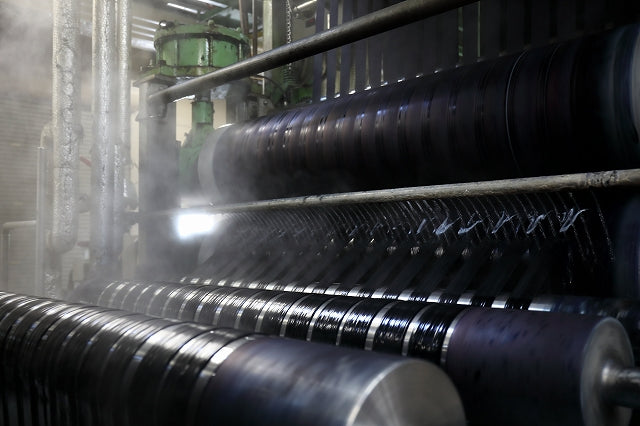
The important aspect of the dyeing process in this project is to dye the rope-shaped yarn while applying exquisite tension, preventing it from being dyed completely to the core. By finishing the yarn with a white core (nakajiro), a fabric that develops the so-called "atari" (fading marks) is created.

The quality achieved by the overwhelming technology of rope dyeing, which we were unable to access for this report due to trade secrets, is something we hope you will experience when the product is finished.
STEP.4 "Weaving"
The spun and dyed yarn finally moves to the weaving process.
Upon arriving at the factory in Okayama Prefecture, the team was greeted by the roar of old-fashioned shuttle looms. This factory is a rare and internationally recognized place in Japan that can operate the G3 model, manufactured by Toyoda Automatic Loom Works (the predecessor of the current Toyota Group's main company), which is arguably the oldest type among "currently operating" shuttle looms in the world.
This factory was chosen because the analysis of the deadstock 501XX, which serves as the base for this project, revealed that the specifications for the number of weft insertions (the total number of warp and weft threads woven into one square inch of fabric) were 6〇 for the warp and 4〇 for the weft, and the G3 model was necessary to achieve these specifications.

Now, what's so good about the G3?
To answer this question, we need to explain the background of how the G-type, considered the ancestor of the G3, came into being.
Sakichi Toyoda, who created the world's first non-stop shuttle changing automatic loom, the "T-type" Toyoda automatic iron loom, in 1903, traveled to the US and Europe in 1910 to further advance looms. After returning to Japan, he repeatedly prototyped based on the information and confidence gained during his visits, and in 1924, he finally completed the non-stop shuttle changing Toyoda Automatic Loom "G-type."
The G-type's impact on the world was immeasurable; it was so significant that Platt Brothers & Co., Ltd. of the UK, the world's largest loom manufacturer at the time, approached him to purchase the manufacturing and sales rights for the G-type worldwide, excluding Japan and the US/China, where he already had export実績. (Incidentally, the patent transfer fee at that time became the initial capital for Sakichi's eldest son, Kiichiro, to develop automobiles.) It's easy to imagine that the arrival of the G-type in the US, where shuttle looms were widely used, even surpassing the UK, a leading textile nation at the time, was a shock. It undoubtedly had a significant influence on American loom manufacturers, including Draper Corporation.
Now, back to the G3. The G3 is a direct descendant of the G-type, a shuttle loom mainly active in the 1950s that was improved to weave thick fabrics. Yes, its track record of exports to the US, its high level of influence, and the era in which it was used are precisely why JELADO chose the G3.


From here, let's introduce the advantages of using old-fashioned shuttle looms, including the G3 model, for denim production.
The biggest difference between modern looms and shuttle looms is the weaving speed. A single loom can weave about 5m of fabric per hour. And it is this slowness that produces the fluffy fabric texture characteristic of the 501XX, which enjoyed the American Golden Age.

Also, compared to the latest rapier looms, which can weave fabric several times wider at about 10 times the speed of shuttle looms, it's important to note that shuttle looms allow for slightly looser tension on the warp. To achieve a rich texture when faded, it's necessary to loosen the warp tension as shown in the diagram below.

Slow speed, narrow fabric width.
Yet, there are still things only shuttle looms can do.
While manufacturing has always evolved to efficiently enrich civilization,
Even in an era of dramatic technological advancement, the human richness born from inefficiency can still exist.

STEP.4 "LAST RESORT"!?"
Denim fabric has finally been completed, using almost the same specifications of cotton as the deadstock 501XX, spun to the exact data, dyed to the same color as the original, and woven under conditions as close as possible to the original.
This is the result of utilizing scientific analysis and liberally applying the skills of Japanese master craftsmen. This fabric itself is a product born during the process of reviving the 501XX for modern times, and it has now been decided that the fabric alone will be commercialized! Its name is "LAST RESORT"!
In the future, it is expected that "LAST RESORT" will be used not only for 5-pocket jeans but also for various other items. When used, a special woven label will be attached, so please look forward to it.

Next Time Preview
Next, we're finally off to the sewing factory!
What will happen to the patterns and materials?!
Stay tuned!!

<Text by Kobotagata / Photos by Seiji Sawada>
~Vol. 3 The Romance of Vintage. Into a Deeper World~ is here
Click here for JELADO's original Last Resort denim line.